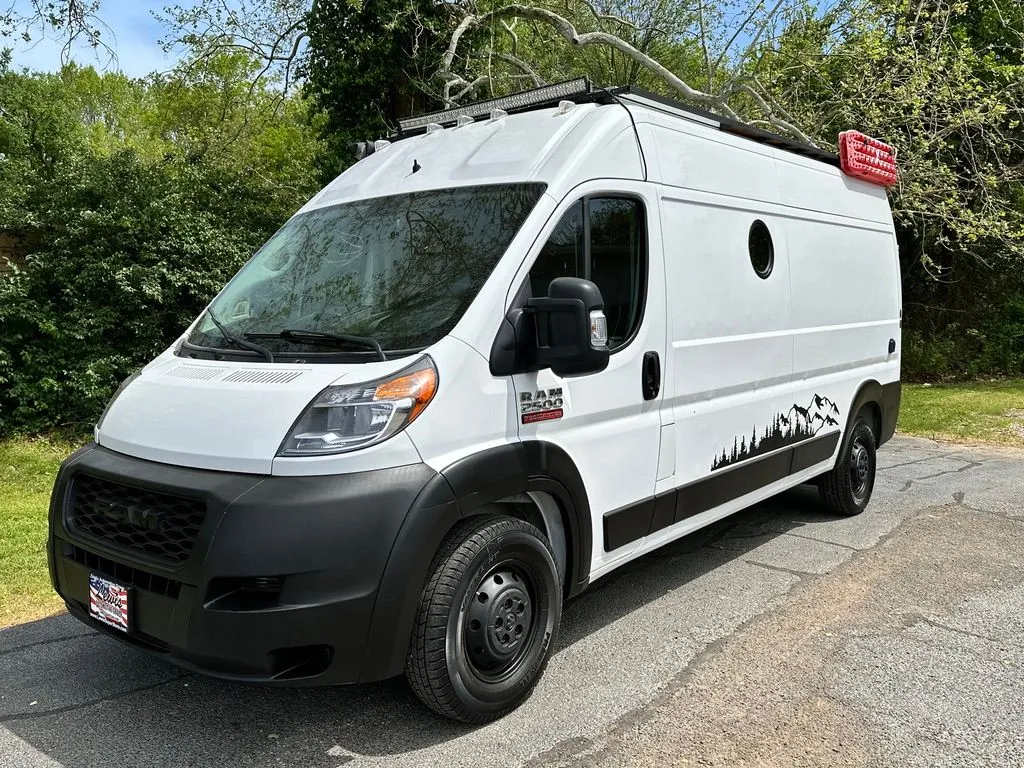
I've been living in a van full-time for over a year now. I work remotely, I fly paragliders, I build LED art for festivals and burns, and my home has wheels. I'm telling you this not to brag but to establish that I'm not writing this from a house with a van parked outside that I take out on weekends. I sleep in this thing every night. I've cooked 500 meals in it. I've sweated through August in Arizona and woken up with frost on the inside of my windows in Oregon. I've rebuilt half the systems I originally installed because I got them wrong the first time.
Most van build guides read like spec sheets written by people who sell solar panels. They'll give you a tidy comparison table and a product link. What they won't tell you is that your carefully planned electrical system will get stress-tested the first time you park under tree cover for a week, or that the fridge placement you thought was fine will drive you insane when you're trying to cook dinner in 40 square feet. This is the guide I wish someone had handed me before I started cutting holes in a perfectly good cargo van.
Section 1The Van Itself Is a Systems Decision
Everyone starts with "which van should I buy?" Ford Transit, Mercedes Sprinter, Ram ProMaster — the forums will argue about this forever. Here's what actually matters: the van you pick determines everything downstream. Roof space for solar. Ceiling height for standing. Chassis weight rating for how much stuff you can bolt inside before you're overweight and chewing through brakes. The vehicle choice is really an architecture decision disguised as a shopping decision.
I went high-roof extended. If you're over 5'10" and plan to live in this thing rather than camp in it, go high-roof. You will stand up thousands of times. The extra few inches of headroom compound over months into the difference between feeling like you live somewhere and feeling like you're hiding in a storage unit. Standard roof makes sense if you're prioritizing stealth parking in cities or want a lower center of gravity on dirt roads, but I'd make that tradeoff again every time.
The brand matters less than the size, the condition of the drivetrain, and whether your local mechanic can source parts. All three major platforms have massive communities, extensive aftermarket support, and known failure points you can research before buying. Pick the one you find in good condition at a price you can afford. Then spend the money you saved on the electrical system, because that's where the real decisions live.
Section 2Power: The Thing You Will Get Wrong
I'm leading with electrical because it's the most consequential system in the build and the one people most consistently undersize. Everything runs on power. Your fridge, your internet, your laptop, your lights, your vent fan, your phone. When the power system can't keep up, nothing else works, and you're sitting in a dark van watching your Starlink blink offline while your food gets warm.
Before you buy a single panel or battery cell, sit down and calculate your actual daily load in watt-hours. Not the optimistic version where you only charge your phone once and the fridge runs at its rated efficiency. The real version. Here's roughly what mine looks like on a work day: laptop at 500Wh, phone and accessories at 100Wh, LED lighting at 200Wh, 12V compressor fridge at 800Wh, Starlink at 1.2-1.8 kWh. That's already pushing 3-3.5 kWh per day before I run anything else. Add a space heater on a cold night or a second monitor for a long work session and you're north of 4 kWh fast.
A 400Ah lithium (LiFePO4) battery bank sounds like overkill until you're trying to run Starlink and a diesel heater controller on a cloudy day in Oregon. I started with 200Ah. It wasn't enough. Lithium costs more than AGM upfront, but it's not even close to a real comparison — lithium gives you 80-90% usable depth of discharge versus 50% for AGM, charges faster, lasts five to ten times longer, and doesn't care about partial charge cycles. The only reason to go AGM is if your budget genuinely can't stretch. If it can, go lithium and buy enough capacity that you're not anxious about power on overcast days.
Pair the batteries with 300-600W of rooftop solar and an MPPT charge controller. Not PWM. MPPT extracts meaningfully more power in real-world conditions, especially in partial shade, which is most parking situations unless you're exclusively boondocking in the desert. Add a DC-DC charger wired to your alternator so you're topping up the house batteries every time you drive. Between solar, alternator charging, and the occasional shore power hookup, you have three redundant charging sources. A 2,000W pure sine wave inverter handles 120V loads — laptop chargers, monitor, the occasional power tool. I've never needed more than that.
The thing nobody tells you about solar: your panels' rated output is a best-case fantasy. A 400W array will produce maybe 250-300W in real conditions, and significantly less when it's cloudy, when you're parked under trees, or when the angle to the sun is wrong. Plan for the bad days, not the spec sheet days. That's why the battery bank matters more than the panels — it's your buffer for the days when generation falls short.
Section 3Internet: Just Get Both
Starlink changed van life. Full stop. Before Starlink, working remotely from public land meant praying for a cell tower within line of sight and dealing with speeds that made video calls impossible. Now I set up a flat antenna on my roof and get 25-100 Mbps from a forest service road in Montana. The hardware is around $600 and the mobile plan runs $135/month. It works, and for remote locations, nothing else comes close.
But here's the thing most Starlink evangelists won't mention: the antenna draws 1.2-1.8 kWh per day. That's a significant chunk of your power budget, roughly equal to your fridge. On sunny days with strong solar production, this doesn't matter. On cloudy days when you're already rationing power, Starlink becomes the biggest discretionary load in your system. I've shut it down on grey days to keep the fridge running, which is the right call but not ideal when you have a deadline.
In practice, I reach for my cellular setup first about 60% of the time. In any area with decent LTE or 5G coverage — which is most places along highways and near towns — a good cellular router with an external antenna outperforms Starlink at a fraction of the power draw. A 100GB+ data plan costs less per month, the hardware uses negligible power, and latency is better for video calls. Starlink comes out when I'm in the backcountry or when cell coverage dies. Having both means I'm never without internet, but cellular is the workhorse and Starlink is the insurance policy.
Section 4The Fridge Is Not Optional
A 12V compressor fridge is the difference between eating actual food and eating gas station food. I know people who tried to do the cooler-and-ice thing for a few months. Every single one of them eventually bought a compressor fridge and wondered why they waited. The cycle of buying ice, draining meltwater, discovering your produce sitting in a puddle at the bottom of a cooler — it gets old fast. A compressor fridge holds temperature, uses less energy over time than constantly buying and melting ice, and means you can buy groceries like a normal person.
I run a 50L unit. For one person, 40-50L is right. If you're a couple, go 60-75L. BougeRV, Dometic, Iceco all make good ones. Chest-opening designs are more thermally efficient than drawer-style because cold air sinks and doesn't dump out every time you open the lid. Mine draws about 800Wh-1,000Wh per day depending on ambient temperature and how often I open it. In summer heat, it works harder. Factor that into your power calculations.
Placement matters more than people think. Put the fridge where you can access it without contorting yourself, but not where it blocks your cooking area or your path through the van. I've seen builds where the fridge is beautiful in photos but requires moving three things every time you want to grab a beer. Live in the van mentally before you commit to a layout. Stand in the empty cargo area, close your eyes, and mime cooking dinner. Where do you reach for ingredients? Put the fridge there.
Section 5Water: Keep It Simple
Van water systems are one of those things people overcomplicate. A 20-30 gallon freshwater tank, a 12V pressure pump, and a basic sink draining into a 5-7 gallon grey water container gets you through three to five days between fills depending on how conservative you are. I use about 3-4 gallons a day for cooking, drinking, and washing dishes. Hot water is a luxury, not a necessity — an Isotemp or small propane unit works if you want it, but I skipped hot water for my first year and didn't miss it as much as I expected.
For showers, a gym membership solves the problem. Planet Fitness is $25/month and has locations everywhere. When you're out on public land, a pressurized camp shower with a bag warmed in the sun gets the job done. Some people install full indoor showers in their vans. Unless your van is huge, that's a lot of space and plumbing for something you'll use for three minutes.
Section 6Climate Control: The Thing Nobody Talks About
Temperature is the silent make-or-break of van life. A metal box amplifies every weather extreme. In summer, the interior can hit 120F in direct sun even with windows cracked. In winter, it's exactly as cold inside as it is outside unless you're actively heating. This is the part that separates full-timers from weekenders, and it's the part that drives people back into apartments.
For heat, a diesel heater is the answer. Webasto and Espar are the premium options. The Chinese clones (Vevor and similar) work fine for a fraction of the price — I know people running them for two-plus years without issues. The diesel heater taps into your fuel tank, uses minimal electricity, and produces dry heat. Propane heaters work but generate moisture as a combustion byproduct, which means condensation, which means mold, which means your bedding smells like a wet dog. Propane also carries CO risk in an enclosed space. Go diesel.
For ventilation, a Maxxair or Fan-Tastic roof vent is the single highest-value item in any build. I'm not exaggerating. This one component controls condensation, eliminates cooking smells, creates airflow for sleeping in heat, and can pull outside air through the van fast enough to drop the interior temperature significantly on warm evenings. If I had to strip my build down to five things, the roof vent makes the list.
What nobody prepares you for is the condensation. You breathe out moisture all night. You cook and produce steam. On cold mornings, every window is dripping, and if your insulation has any gaps, moisture gets behind the walls and breeds mold. Proper insulation, vapor barriers, and that roof vent running on low while you sleep — these aren't nice-to-haves, they're structural requirements for a van you can live in long-term.
Section 7The Space You Live In
A fixed bed versus a convertible setup is a lifestyle question, not a layout question. I went fixed bed and have never regretted it. The idea of folding and unfolding a sleeping platform every morning and every night sounds manageable until you've done it 200 times. A fixed bed with storage underneath gives you a place that's always ready for sleep and a massive garage space below. You lose some floor area, but you gain sanity.
If you work remotely full-time, your workspace deserves as much thought as your kitchen. I spent months working hunched over a laptop on my bed before I built a proper desk setup with a monitor arm, a stable surface, and a seat with actual back support. The difference in daily comfort and productivity was immediate and dramatic. Your body doesn't care that you live in a van — it still needs ergonomic support. A laptop on a pillow is not a desk, no matter what the Instagram photos suggest.
Section 8The Honest Tradeoffs
Van life content online leans hard toward the romance. Sunsets, mountain views, coffee with a backdrop. That stuff is real, and it's genuinely great. But there are tradeoffs that people don't mention, and they're the things that determine whether this lifestyle lasts for you or whether you're back in a lease within six months.
Parking anxiety is constant, especially in cities. Where am I sleeping tonight? Is this street legal? Will I get a knock at 2 AM? You develop an instinct for it, but it never fully goes away. Temperature extremes are relentless — I've described the systems, but no system makes a metal box feel like a climate-controlled apartment. You learn to chase temperate weather, which is actually one of the great freedoms of van life: when it gets too hot, you drive north. When it gets cold, you go south. You follow seasons instead of fighting them.
Loneliness is the one I didn't expect. The freedom is incredible — waking up at a trailhead, working from a national forest, flying a new paragliding site every week. But long stretches alone in a small space can wear on you in ways that take time to notice. The van life community helps. So does having friends scattered around the country that you can park near for a while. I wrote about the flip side of this — how shared adversity builds bonds fast — in my piece on type-2 fun at Burning Man. Living in a van is type-2 fun about 30% of the time. The other 70% is genuinely just good.
There's a different version of this mobile life that I experienced hiking hut to hut in Norway — same philosophy of carrying what you need and moving through landscapes, but with four walls and a wood stove waiting at the end of each day. Both approaches taught me the same thing: you need far less than you think, and the stuff that actually matters fits in a surprisingly small space.
Section 9Just Build the Damn Van
Build paralysis is the most common failure mode in van life, and I've watched it kill more builds than bad wiring. People spend eight months in SketchUp optimizing a floor plan for a van they haven't bought, researching the perfect battery chemistry, reading one more comparison review. At some point the planning becomes the project instead of the van.
Here's the truth: you will get things wrong. I got my battery bank wrong, my fridge placement wrong, and my desk setup wrong. I fixed all three. The battery upgrade took a weekend. The fridge moved in an afternoon. The desk cost $40 in plywood and hardware. None of these were catastrophic. None required gutting the build. The van build that exists and gets lived in will always beat the perfect van build that stays in a planning document.
Start with the core systems — power, internet, fridge, sleep surface, ventilation. Get those right enough to be functional. Then go live in it. Within two weeks you'll know exactly what needs to change, and those changes will be informed by actual experience instead of forum speculation. The van community shares knowledge generously, and someone on a van life subreddit or a build forum has already solved whatever problem you're about to encounter.
The logistics of van life are learnable. Parking apps, water fill stations, dump points, dispersed camping rules — all of it becomes routine within a month. What takes longer to figure out is whether the tradeoffs are worth it for you. Whether waking up somewhere new, working on your own schedule, chasing weather and seasons and flying sites, with no lease and no commute — whether that's worth the parking anxiety and the condensation and the occasional rough night. I'm a year in, and for me, it is. But that's something you can only learn by doing it, not by reading about it.