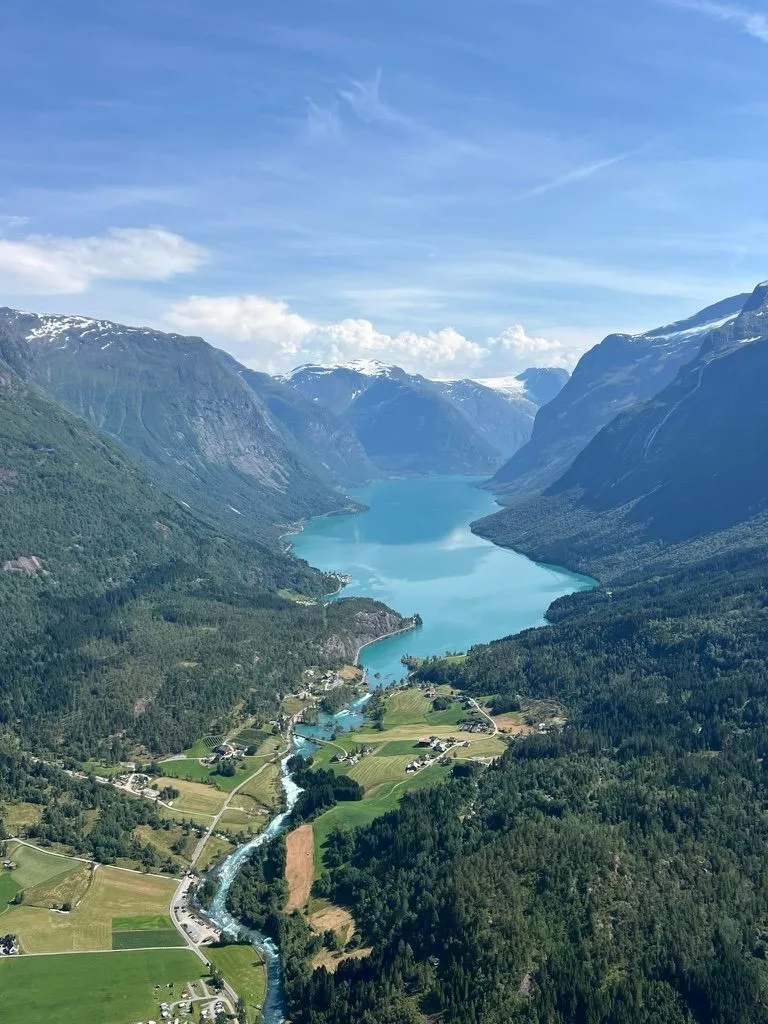
Most people who fly paragliders in Europe head to the Alps. Chamonix, Interlaken, the Dolomites — that's where the comps are, where the Instagram edits come from, where the thermal gods supposedly live. And they're not wrong. But western Norway does something the Alps rarely do: it gives you a full day of flying in completely different modes. Morning soaring on smooth coastal air, afternoon thermals feeding off steep fjord walls, and an evening window where the light goes golden and the lift keeps cycling long after you'd expect it to die. I flew both Voss and Stavanger on the same trip, and the range between the two sites was wider than I expected.
The biggest adjustment? The air feels different up here. Not worse — just different. The thermals are softer than what you get in, say, Roldanillo's punchy Colombian valley air. They organize more slowly, build more gently, and top out lower. But they're also more predictable once you learn the pattern, and the scenery below you — fjords cutting into granite, snow sitting on ridgelines in July, water so dark it looks black from altitude — makes every flight feel bigger than the numbers on your track log.
Section 1Voss: The Gondola Loop
Voss is the more accessible of the two, and the setup is almost suspiciously convenient. The Voss Gondol runs from the center of town up to Hanguren at around 820 meters ASL in about nine minutes. South-facing launch. Lake landing zone (Vangsvatnet) practically at the base station. The whole loop — fly, land, repack, ride up, fly again — takes maybe forty minutes if you're efficient. On a stable morning before the thermals turn on, you can do three or four laps before lunch. That kind of volume is rare. Most sites make you hike or drive back to launch, and by the time you get there the conditions have changed. At Voss, you barely have time to drink your coffee before you're in the air again.
The morning flights are the calm ones. Smooth laminar flow off the south-facing slope, easy ridge soaring, clean glide paths to the landing field by the lake. It's the kind of flying that makes you a better pilot almost without trying — you're running approach after approach, dialing in your landing accuracy, getting comfortable with the terrain. One morning I launched into air so smooth it felt like the wing wasn't moving. The lake below was dead flat, perfectly reflecting the mountains, and for about thirty seconds during the glide I couldn't tell where the real ridgeline ended and the reflection began. I landed on the grass strip next to the gondola station, and by the time I'd stuffed the wing back in its bag, the next car was already loading.
Then late morning hits, and the character of the site shifts. The sun gets high enough to heat the rocky terrain above the gondola station, and thermals start punching through. On a good day — clear skies, light winds, no frontal weather — cloudbase sits between 1,400 and 2,000 meters. That's real XC altitude. The classic route is Voss to Ulvik, about 40 km, following the fjord and mountain terrain east. You're flying over a landscape that looks like someone took a topographic map and turned the relief dial to maximum. Deep valleys, vertical rock faces, water everywhere. The thermals kick off the south-facing slopes and the darker rocky outcrops, and once you're above the ridge line, the whole eastern horizon opens up.
One thing nobody tells you beforehand: bring cash for the bus back from Ulvik. There's no convenient retrieve unless someone's driving for you. The bus back from Ulvik runs twice a day in summer, and I managed to land just in time for the afternoon departure. Sat in the back row with the wing bag taking up two seats, watching the fjord scenery scroll past. A local pilot had warned me: "Always check the bus schedule before you launch east." He wasn't kidding.
There's a secondary launch about 200 vertical meters below the main one, also south-facing, for days when the wind at the top is too rowdy. Good to know about before you haul your gear up and find the flags ripping horizontal.
Section 2The Sea Breeze Problem
This deserves its own section because it's the thing that'll catch you if you're not watching for it. Voss sits at the inland end of a valley that runs down to the coast. Every afternoon — and I mean every afternoon in summer — the onshore sea breeze pushes up that valley. You can see it coming if you know where to look: the surface of Vangsvatnet. When ripples start forming and pushing consistently from the west, you have maybe fifteen to twenty minutes before the breeze reaches launch altitude and the flying window slams shut.
The transition isn't gentle. You go from orderly thermals to a confused mess of crossing air masses as the cool marine air undercuts the warm valley air. I watched a pilot get caught in it and end up over the lake with no clear glide path to the landing field. The local club keeps a boat on Vangsvatnet specifically for this — which tells you how often it happens. Don't be the person who makes them launch it. When the lake starts rippling, land. I watched it happen to someone else first, which was lucky. A pilot who'd been climbing nicely in a thermal suddenly started drifting backward — the sea breeze had arrived at his altitude while the surface still looked calm. He made it to the LZ, but his ground track showed a crab-walk angle of about 45 degrees. I landed ten minutes later and didn't go back up.
Section 3Ekstremsportveko
The last week of June, Voss hosts Ekstremsportveko — Extreme Sports Week. Acro comps, distance tasks, spot landing on rafts in the lake, base jumping, whitewater kayaking, the works. The whole town turns into a carnival for people who think falling is a sport. If that energy appeals to you, time your trip around it. If you'd rather fly without twenty other wings in your thermal, avoid it. There's no in-between. I went during Ekstremsportveko, which was electric. The whole town was full of people carrying skydiving rigs, BASE systems, kayak paddles — gear for sports I didn't even recognize. The flying was busier than usual, with competition pilots doing acro maneuvers I had no business being near. But the evening sessions after the comps ended were some of the best flying of the trip — empty air, golden light, and the kind of quiet that only happens when everyone else has gone to the pub.
Section 4Stavanger Region: Øksnanuten
Forty kilometers southeast of Stavanger, in Gjesdal, sits Øksnanuten. It's less flashy than Voss, less Instagrammable, less set up for quick laps. It's also, in some ways, better flying.
The main advantage is wind flexibility. Øksnanuten works in almost all wind directions, which matters enormously when your weather comes off the North Sea and changes its mind every six hours. At Voss, a northwest wind shuts you down. At Øksnanuten, you just move to a different part of the hill. That kind of reliability is hard to overstate when you've traveled to a site and have a limited window.
The evening soaring is the real draw. Even after thermals have collapsed everywhere else, Øksnanuten holds a ridge lift cycle well into the Nordic summer evening — which, at this latitude in June, means you can be flying at 10 PM in full golden light. The slope faces catch the low-angle sun and keep generating enough differential heating to maintain a workable cycle. It's the closest thing I've found to a cheat code: everyone else has packed up, and you're still up there, watching the shadows stretch across the fjord system below.
The last flight of the day was around 9 PM. The air had gone completely smooth — no thermals, just a gentle ridge cycle that held me at about 200 meters above launch. The sun was sitting on the horizon, turning the fjord below into a sheet of copper. I could see the shadow of my wing sliding across the hillside, perfectly sharp in that low-angle light. I stayed up for forty minutes, and when I finally came in to land, the field was empty except for a farmer walking his dog who gave me a nod like this was the most normal thing in the world.
Section 5XC From Stavanger: The Fjord System
Once you're at altitude above the Stavanger region, the XC potential opens up in a way that feels fundamentally different from alpine flying. The fjord system creates channels for air movement — long, parallel corridors between granite walls — and those channels produce thermal lines that are remarkably consistent. Instead of hunting individual thermals, you find a line and ride it. The transitions between thermals are shorter because the terrain funnels everything into predictable paths.
The marquee route takes you over Lysefjord — the same fjord that Preikestolen (Pulpit Rock) overlooks. Flying above that canyon is a different experience from any valley flying I've done elsewhere. The scale is disorienting. The walls drop 600 meters straight into water that's dark enough to look like ink, and the thermal triggers along those walls create a rolling conveyor of lift if you know where to position yourself. The canyon generates its own microclimate — warmer air pooling in the fjord, cooler air flowing off the plateau above — and that differential drives reliable thermals even when the surrounding terrain has gone flat. If you've done XC in alpine valleys where thermals fire off random rock faces and you're constantly guessing, the fjord system will feel weirdly organized. Like someone laid out the thermal sources in a grid.
For a broader look at what else the Stavanger and Voss region has to offer beyond flying — the hikes, the DNT huts, the weird tropical garden — the southwest Norway travel guide covers the ground-level stuff in detail.
Section 6Season, Timing, and Light
The flying season runs roughly April through September, but the sweet spot depends on what you're after. April and May bring longer days and the first usable thermals, but conditions are inconsistent — you'll have great days mixed with complete washouts. June and July are peak: strong thermals, high cloudbase, and — this is the part that changes everything — nearly 20 hours of daylight. You can launch at 6 AM and still have flyable light at 10 PM. That extended window isn't just nice to have. It means morning flights, afternoon XC, and an evening session at Øksnanuten, all in the same day. If you're used to the tight 11 AM to 5 PM thermal windows in most of the world, Norway in midsummer feels like someone removed the time limit.
August and September see shorter days and softer thermals, but also fewer pilots and more stable conditions. September, particularly, can produce clean, smooth days with long glides and no turbulence — the kind of flying that's almost meditative. The Romsdal region farther north gets even more extreme with the daylight — nearly 20 hours in June — and has its own adventure scene worth combining with a paragliding trip if you're in Norway for more than a few days.
Section 7Logistics for Visiting Pilots
Norway recognizes foreign pilot licenses. Carry your rating card, proof of membership in your national organization, and third-party insurance documentation. The Norwegian Airsport Federation (NLF) handles the regulatory side, and in practice nobody has hassled me about paperwork at either site. Just have it in your bag.
Getting between Voss and Stavanger takes about three hours by car. Both sites have reasonable accommodation nearby — Voss is a proper town with hostels, hotels, and camping, while the Stavanger region has more spread-out options around Gjesdal. Norway is expensive. Expect to spend 250-400 NOK on meals, 150-200 NOK on coffee that you'll drink too much of because the days are so long. The gondola at Voss runs around 200 NOK per ride, but check for multi-ride passes if you're planning to do laps — they sometimes offer deals during peak season.
If you have a rest day forced by weather — and you will, the North Sea doesn't care about your schedule — the DNT hut-to-hut hiking network is worth exploring. Norway's 590 trail huts run on an honor system that still feels slightly unbelievable, and a day hike between huts is a good way to see the terrain from the ground that you've been reading from the air.
Section 8Who Should Fly Here
Norway isn't the place to learn paragliding, and it's not the place for your first XC flights. The terrain is steep, the water landing potential is real, and the sea breeze dynamic requires judgment that comes from experience. If you've been flying for a while and want a site that rewards patience and pays in scenery, this is it. If you're still building your fundamental flight skills, get those dialed in first and come back when you're ready to use them.
What surprised me most about flying in Norway wasn't the fjords or the thermals or the endless light. It was the silence. At altitude, with the wing inflated above you and no engine noise, you hear the wind in the lines and nothing else. No road noise, no music from a village below, no dogs barking. Just air moving over fabric and the beep of your vario when you hit lift. It's the quietest version of this sport I've experienced, and after a week of it, everything else felt loud. I'd go back for the Stavanger side specifically. Voss is convenient and the gondola laps are addictive, but the evening flying at Øksnanuten and the XC potential over the fjord system stuck with me more. Next trip, I want to try the route over Lysefjord with a proper retrieve plan and enough altitude to really use the thermal lines the canyon produces. Norway makes you a more patient pilot, which is the kind of thing you don't realize you need until you have it.