Section 1Most Countries Make Wilderness Harder Than It Needs to Be
The standard backcountry model goes like this: carry everything on your back, filter your own water, eat rehydrated meals, sleep in a tent you hauled up 3,000 feet of elevation gain, and repeat until your knees give out or your food runs out. It works. People love it. But Norway looked at that model and decided to build something better.
The Norwegian Trekking Association — DNT, if you want to sound like you've been there — maintains over 550 mountain huts scattered across the Norwegian backcountry. They're spaced a day's hike apart, they're stocked with food and firewood, and most of them don't require reservations. You show up, you sleep, you pay on the honor system. That's it.
The result is that you can string together week-long traverses through some of the emptiest mountain terrain in Europe carrying nothing but a daypack, a sleep liner, and maybe a change of socks. No tent. No stove. No 50-liter pack destroying your lower back. I spent time hiking through the hut network in southern Norway, and the thing that surprised me most wasn't the landscape — it was how light my pack felt. You forget what hiking is like when you're not hauling your entire life on your shoulders.
Section 2Three Types of Huts (and Only One Matters)
DNT huts come in three tiers, and understanding the difference will determine what kind of trip you have.
Staffed huts are the most comfortable. These are basically mountain lodges — someone cooks dinner for you (usually fish, often trout pulled from a nearby lake), there are real beds with duvets, sometimes a shower if you're lucky. You show up, eat, sleep, leave. They're open roughly late June through mid-September, and the popular ones in Jotunheimen fill up in July. These are fine. They're also the least interesting part of the system.
Self-service huts are the real experience. These are unmanned cabins stocked with firewood, gas burners, cooking gear, and a pantry of provisions — tinned fish, rye crackers, instant soup, coffee, sometimes pasta and sauce. You let yourself in with the DNT key, cook your own food, chop your own firewood if the stack is getting low, clean up after yourself, and settle your bill through the DNT app or by stuffing a payment form in the box by the door. Nobody checks. Nobody hovers. The whole thing operates on trust, and it works because — well, because it's Norway.
No-service huts are the same setup but without stocked provisions. Just shelter, firewood, and basic cooking gear. These tend to be in the most remote areas where resupply is impractical. You bring your own food but still get a roof, a wood stove, and dry walls. Useful for extending routes deeper into the backcountry where the self-service huts thin out.
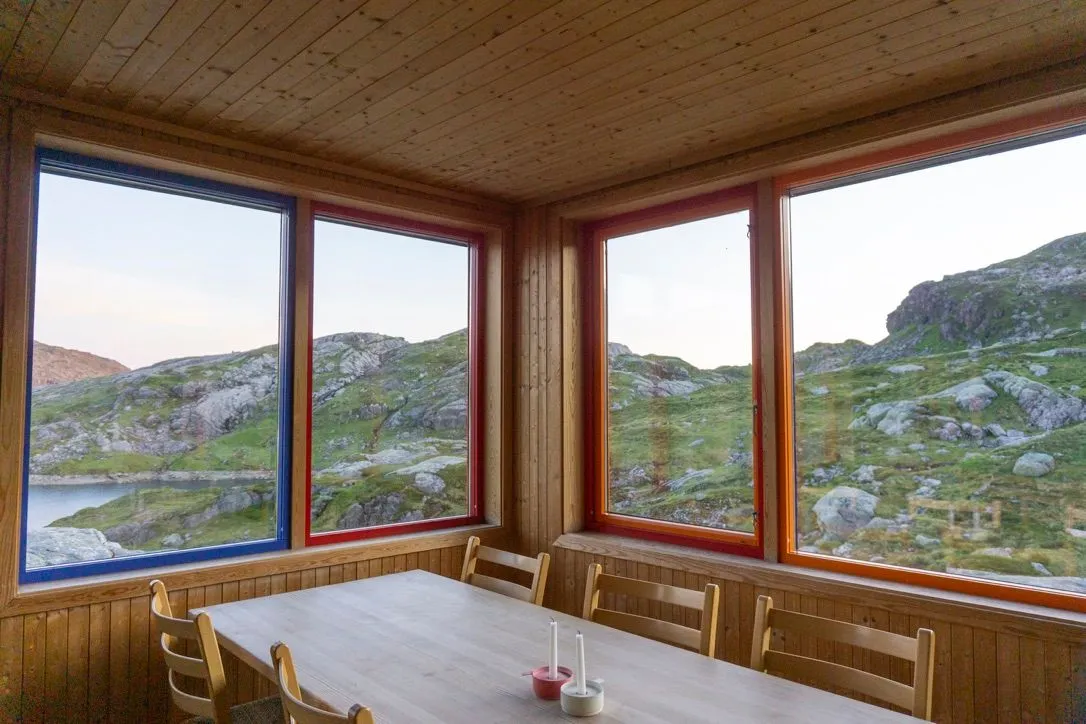
The self-service huts are where this system becomes genuinely special. The first self-service hut I reached was on Hardangervidda after a day in weather that kept changing its mind — sun, fog, drizzle, sun again, all within twenty minutes. The hut appeared as a dark rectangle against the grey-green tundra, and I was so focused on getting there that I nearly walked past it. Inside: woodsmoke, damp wool, a stove someone had left burning low. A German couple in their sixties were eating tinned fish on crackers at the table, and they poured me a cup of coffee without asking whether I wanted one. We sat there for an hour, barely talking, watching the clouds move across the plateau through the window. No one asked for a reservation number.
Section 3What It Costs
DNT membership runs about 725 NOK per year (roughly $70 USD). If you're staying at more than two or three huts, it pays for itself immediately through discounted rates.
With membership, a night at a self-service hut costs around 200-315 NOK ($20-30) without food. You pay separately for whatever provisions you eat from the pantry — there's a price list posted inside each hut, and you log what you took on the payment form. Full board at a staffed lodge is roughly 1,100 NOK ($105) member price, which includes dinner, breakfast, and a packed lunch for the trail. Non-members pay a premium of 200-400 NOK more per night.
The other thing membership gets you is the universal DNT key — a small metal key (100 NOK deposit, refundable) that opens every locked self-service and no-service cabin in the entire network. Without it, you're limited to staffed huts and the handful of self-service huts that are left unlocked. With it, the whole system opens up.
Section 4Planning a Route
UT.no is the main route-planning tool. It's in Norwegian, but Google Translate handles it well enough that you can figure out distances, elevation profiles, and which huts are along each route. The interface is a little clunky — think a government-funded trail database rather than a slick app — but the data is solid and it shows you exactly where the huts are, which ones are staffed vs. self-service, and whether they're open.
On the trail, navigation is straightforward. Marked routes are blazed with red T's painted on cairns and rocks, and they're maintained well enough that you rarely lose the trail unless fog rolls in and the visibility drops to twenty meters. Which happens. Regularly. Carry a map and compass as backup even on marked routes — the Norwegian mountains aren't tall (the highest peaks top out around 2,400 meters) but the weather changes fast, and a whiteout on open plateau is disorienting in a way that forested trails aren't.
Distances between huts typically run 15-25 km, which translates to 6-8 hours at a moderate pace depending on the terrain and how much elevation you're gaining. The terrain in southern Norway is mostly open — above treeline for long stretches, crossing boulder fields, boggy patches, and the occasional snowfield into early July. It's not technical, but it's slow going in places, especially when the ground is wet. Good boots and gaiters make a bigger difference here than in most mountain environments.
Section 5When to Go and What to Bring
The window is late June through August. Earlier and you'll hit snow on the passes and find the staffed huts closed. Later and the weather turns and daylight shrinks, though September can be gorgeous if you're comfortable with shorter days and colder nights.
July is peak season. The most popular huts in Jotunheimen — places like Gjendesheim and Fondsbu — fill up, and the ridge traverse along Besseggen gets crowded enough that it barely feels like backcountry. If you want solitude, go in late June or August, or pick routes in Hardangervidda or Rondane instead of Jotunheimen. Fewer people, same quality of terrain.
One thing that throws people off: the light. At that latitude in midsummer, you get maybe four hours of semi-darkness. The sun dips below the horizon around 11 PM and comes back up before 4 AM. It's disorienting at first — your body doesn't know when to stop hiking — but it also means you're never racing sunset. If you're moving slow and it's 8 PM, you've still got three hours of full daylight. Bring a sleep mask. The huts have curtains but they don't block everything, and your brain will fight you on sleeping at 10 PM when it looks like mid-afternoon outside.
Packing for hut-to-hut is blissfully simple compared to a full backpacking setup. You need a sleep liner (silk or merino — the huts provide duvets and pillows), layers for unpredictable weather, rain gear, good boots, a water bottle, and a small first aid kit. That's essentially it. If you're doing only staffed huts, you don't even need to carry food. If you're mixing in self-service huts, bring backup snacks and anything specific you want that the pantry might not have — fresh fruit, chocolate, whatever keeps you sane after day four of rye crackers and tinned mackerel. If you've hiked multiday routes like the W Trek in Patagonia, the DNT system is a similar refugio concept but with far less bureaucracy and no reservation lottery. Check our W Trek packing list for a solid baseline — the layers and rain gear translate directly, minus the tent and cooking setup.
Section 6The Routes Worth Your Time in Southern Norway
Jotunheimen gets the most attention, and for good reason — the peaks are the highest in Norway and the terrain is dramatic. Besseggen Ridge is the most famous single day hike, a knife-edge traverse between two lakes at different elevations. It's earned the reputation. But do it early in the season or late in the day if you can, because in peak July it becomes a procession.
Hardangervidda is the opposite energy — Europe's largest mountain plateau. No peaks, no knife edges. Just an enormous expanse of open tundra stretching to the horizon in every direction, dotted with lakes and crossed by rivers. It's where wild reindeer herds still roam. Walking across it feels more like the Arctic than what most people picture when they think of Norway. The self-service huts here are well-spaced and relatively quiet.
Rondane is the oldest national park in Norway and probably the most underrated for hut-to-hut hiking. The terrain is gentler than Jotunheimen, the trails are well-marked, and you'll have entire valleys to yourself even in July. Good option if you want the DNT experience without the crowds.
I did a four-day loop on Hardangervidda, starting from Haukeliseter and moving east through Hellevassbu and Torehytten before circling back. Hellevassbu was the standout — a small wooden cabin sitting alone next to a lake that reflected the sky so perfectly it looked like the hut was floating. I arrived to find it completely empty, stocked with everything I needed, and spent the evening sitting on the front step watching reindeer move across the far ridge. No other hikers showed up that night. It was the quietest place I've ever slept.
Section 7A Few Things Nobody Tells You
The self-service huts operate on a pantry system, and the provisions are... functional. Expect tinned mackerel, sardines, rye crackers (knekkebroed — you'll eat more of this than you thought possible), instant soup packets, coffee, tea, and occasionally pasta or rice. It's calories, not cuisine. After three days of this, you'll fantasize about vegetables. Plan accordingly.
Water in the mountains is generally drinkable straight from the streams, which is a luxury you don't appreciate until you've spent time in places where you can't do that. Fill up at every stream crossing — the stretches between water sources on the plateau can be longer than you expect.
The huts have a communal log book. Everyone writes in it — where they came from, where they're headed, observations about trail conditions. Read these. They're the best source of current beta on snow conditions, river crossings, and whether the next hut's woodpile is running low. Some entries are borderline poetry. Norwegians get philosophical when they're alone in the mountains.
If you're combining hut hiking with other activities in the region — there's plenty to do between Stavanger and Voss beyond the trails, and the climbing in Romsdal is worth the drive north. If you fly, paragliding out of Voss is one of the best flying sites in Northern Europe.
Section 8The Point of All This
Most trail systems are designed around the assumption that you're self-sufficient. Norway flipped that assumption. The DNT network says: the mountains should be accessible to anyone willing to walk, not just people who can carry 60 pounds and navigate without trails. That philosophy — that wilderness access is a public good, not an endurance test — is what makes the system work.
It also changes what hiking feels like. When you're not hauling a tent and a week of food, you notice more. You walk faster or slower depending on what you want, not on how many miles you need to cover before dark. You sit by a lake for an hour because you can. You have conversations with other hikers at the huts in the evening because you're not exhausted and because the coffee is already made. The hiking becomes the point, not the logistics.
On the last evening, at a hut with three other hikers I'd been leapfrogging all day, a Norwegian woman in her seventies pulled out a flask of aquavit and poured four glasses without saying a word. We sat around the stove, boots drying in a row by the door, and she told us she'd been hiking hut to hut every summer since 1974. Fifty years of the same trails, the same huts, the same system. "Norway changes," she said. "The mountains don't." We clinked glasses and I watched the 11 PM light turn the plateau outside the window into something that looked like it had been there since the beginning of time. It probably had.