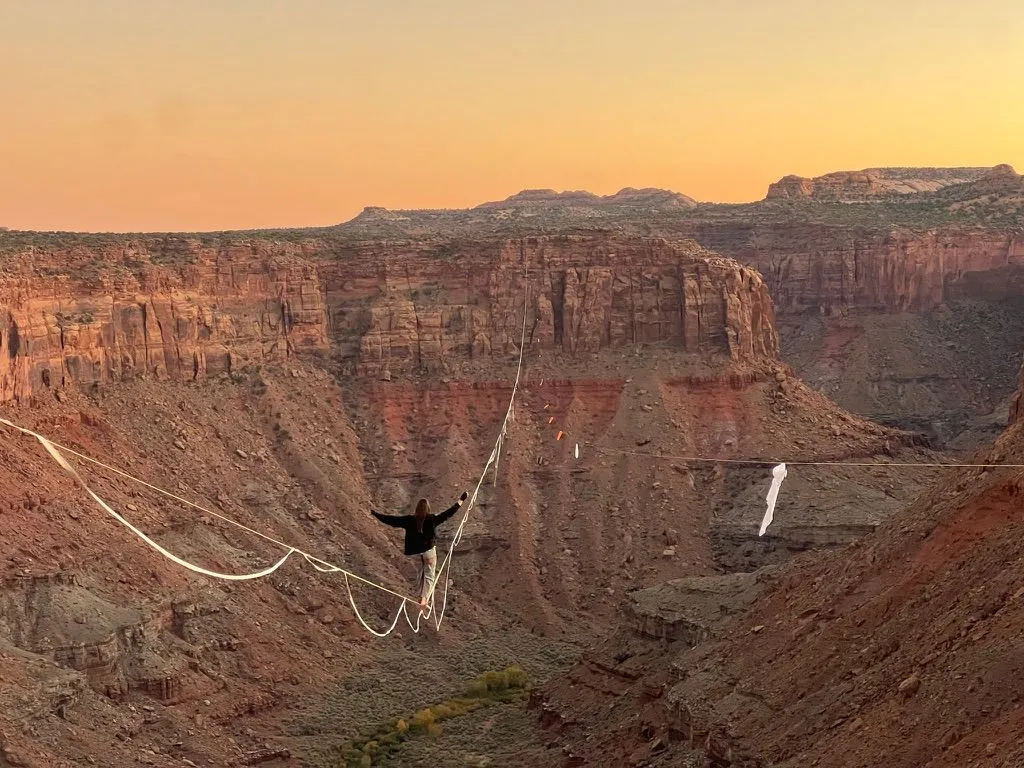
There's a moment on a long highline — somewhere past the first hundred meters, deep in the sag where the anchors are just geometry above you — when you realize this is not the same activity as the 30-meter line you learned on. Your feet know the same webbing. Your leash clips to the same backup. But the physics are different, the stakes are different, and the project that got this line across the gap bears almost no resemblance to rigging a park line. If you've been walking shorter lines and wondering what big-line culture is really about, here's what changes and why it matters.
Section 1What "Long" Actually Means in Practice
There's no official cutoff. But in practical terms, the community treats anything over 200 meters as a long line. Above 500 meters, you're talking about a project — multiple days, a team, serious logistics. The current world records are measured in kilometers.
The shift isn't gradual. It's not like each extra 50 meters adds a little more difficulty. There are thresholds where the whole character of the problem changes. Around 200 meters, wind starts mattering in ways it didn't before. Around 300, the sag profile becomes aggressive enough that walking technique has to fundamentally adapt — you're climbing uphill for half the line and descending the other half, with the lowest point sagging meters below the anchor plane. Around 500, the sheer weight of webbing becomes a logistical constraint. A 600-meter line in 20mm Spider Silk MK5 weighs about 24 kilograms. Just the webbing. Add tensioning gear, anchoring hardware, backup line, leash kits, and you're looking at 40-plus kilograms of gear that needs to reach a remote anchor, often via a trail that doesn't exist.
On a project in the Southwest, four of us split about 50 kilograms of gear across our packs and hiked two hours up a trail that didn't really exist — loose scree, a few exposed traverses, all of it in pre-dawn dark with headlamps. By the time we reached the anchor, my quads were done and we hadn't even started rigging. The gear pile at the top looked like someone had raided an REI and dumped it on a ledge.
Section 2Getting the Line Across the Gap
On a 30-meter line you throw a bag or walk it around. On a 300-meter canyon gap with a 200-meter drop, that's obviously not happening. This is where big-line rigging becomes its own discipline.
Tagline progression is the most common method and the one every long-line rigger should understand. You start with the lightest cord you can manage — usually 3mm or 4mm Spectra, sometimes thin Dyneema — and get it to the other side by throwing it, hiking it around, or flying it. Then that cord pulls a heavier line across. Then that pulls a heavier one. Then the main webbing. Each cord is a messenger for the next. It's slow. It's physical. On a big gap, the tagline pull alone can take hours, and if your cord snags on a rock feature halfway across you're starting over.
The feel of a tagline pull is something you don't forget. You're hauling hundreds of meters of cord through space, watching it arc across a void, feeling the drag build as the weight accumulates. When the far-side team finally clips in and tensions the cord taut, there's a specific vibration that runs through the whole system — that's the moment it becomes real. On one pull across a canyon gap, the cord snagged on a rock feature about two-thirds of the way across. We spent twenty minutes trying to flick it free from the near side — pulling at angles, shaking the line, all of it useless. Someone eventually had to scramble down and around to free it by hand, which added an hour to the day. When the far-side team finally clipped in and the cord went taut across the gap, the relief was physical — everyone exhaled at the same time.
Drones changed the game in the last few years. A capable drone can carry a lightweight tagline across a gap where no trail exists — overhangs, gaps with no approach on one side, alpine features where the only other option is technical climbing. It's not foolproof. Wind limits what you can fly, battery life limits distance, and regulations vary by location. But for projects where the alternative is a full day of rope work just to establish the first crossing line, a drone cuts the timeline from hours to minutes.
Rope guns — a climber who leads or rappels to place hardware and carry the line across — are the solution for big-wall or cliff-face setups. If the anchors require climbing access, someone has to go out there on rock. This is where highlining overlaps with trad climbing, and it's part of why the two communities share so much DNA.
Section 3Anchor Forces: The Math Gets Serious
On a short line, anchor forces are manageable and somewhat forgiving. On a 500-meter line at reasonable walking tension, each anchor is seeing 15 to 25 kN. That's between 3,400 and 5,600 pounds of force pulling on whatever you've rigged to. The margin for casual engineering disappears entirely.
Equalized anchors — systems that distribute load across multiple attachment points — become mandatory rather than best practice. The specific setup depends on terrain. Rock horns, bolted anchors, trees, boulder wraps. The principle is constant: no single point carries the full load. If one anchor point fails, the remaining points need to hold. This is redundancy engineering, and it's where the difference between someone who rigs highlines and someone who rigs long highlines shows up most clearly.
Padding is the other thing that separates experienced riggers from everyone else. Anywhere webbing contacts rock, it needs protection. I've seen what happens when a loaded line runs over an unpadded edge under repeated dynamic loading — the sheath abrades faster than you'd believe, and the failure is sudden. Not gradual. Not a warning. Sudden. On one rig, we found a section of backup webbing that had been running over an unpadded sandstone edge for two days. The sheath was fuzzy and flattened across about four inches — looked like someone had taken a belt sander to it. The core fibers were intact but visibly stressed. We retired it on the spot and re-padded everything with double layers. That was the day I stopped thinking of padding as optional. Carry more padding than you think you need. Then carry more.
Section 4Working Load Limits: The Number That Keeps You Alive
MBS — Minimum Breaking Strength — tells you when something fails. It's the number on the spec sheet. WLL — Working Load Limit — tells you how much you should actually put on it. The difference between these two numbers is where your safety margin lives.
For most highline rigging, a 3:1 safety factor is the minimum. If your line will see 10 kN of tension, every component in the chain needs an MBS of at least 30 kN. That sounds straightforward until you're running through a system with 15 different components and each one has a different rating. The weakest link sets the ceiling for the entire rig.
Here's where long lines get tricky: the forces are higher, so components that are perfectly adequate on a 50-meter line suddenly become the weak point. A quicklink that's fine for a backup anchor on a park line might be pulling at its WLL on a 600-meter rig tensioned to 20 kN. You have to check every component through the full system, not just the ones that feel important. The shackle is obvious. The quicklink connecting your backup to the anchor — that's the one people miss.
Section 5Why the Community Won't Let You Skip Steps
There's a reason experienced riggers are careful about who they teach and how fast. Everything in this article is conceptual. The actual skill — reading an anchor, feeling whether tension is right, recognizing when a tagline pull is going wrong, knowing when wind conditions mean you don't tension today — comes from doing it alongside people who've done it hundreds of times.
This isn't gatekeeping. It's the opposite. The highlining community is genuinely generous about teaching. I learned by showing up and carrying gear. My first few projects, I was basically a pack mule — hauling webbing, holding things in place while experienced riggers made decisions, asking questions when there was a natural pause. Over maybe a dozen projects, the mentors gradually let me handle more. First it was padding and backup connections. Then anchor building under supervision. Eventually, tension calculations and system checks. Nobody handed me a certification. I just did enough reps that the people around me trusted my judgment. But they won't let you skip the progression, because the consequences of bad rigging on a long line aren't a broken piece of gear. They're catastrophic.
If you're at the stage where this article is interesting but you haven't rigged anything longer than 100 meters, the next step isn't buying Silk 99. It's finding the community in your area and showing up. Experienced riggers can spot someone who's done their homework, and they'll bring you along faster than you'd expect.
For the gear side of long-line rigging — why Spider Silk and Silk 99 exist, how the sandwich system works, and what hardware pairs with 20mm webbing — the companion piece covers the specifics.