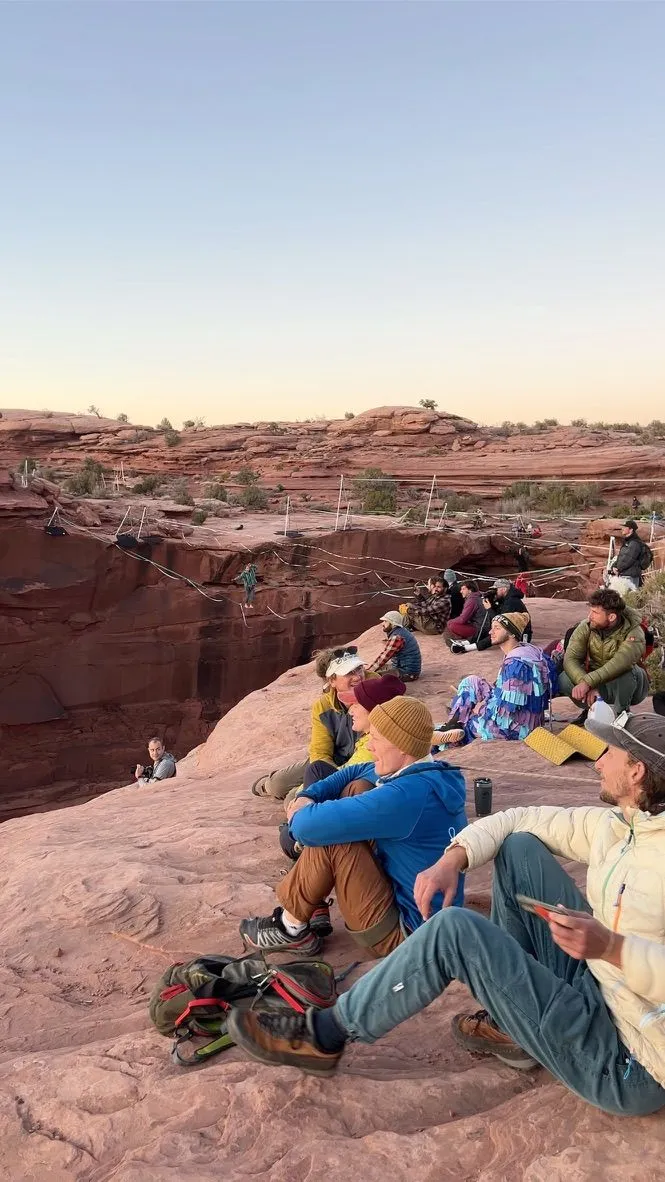
Highlining has a reputation as an extreme solo pursuit — one person, a thin ribbon of webbing, an enormous void. That image isn't wrong, but it misses something fundamental about how the sport actually works. You can't learn to rig a highline safely from YouTube. The knowledge lives in the community, passed person to person, and that's not an accident.
Section 1What Highlining Actually Is: Freestyle, Long-Distance, and Speed
Before getting into the community side, it helps to understand how varied the sport actually is. Most people picture someone inching across a thin line over a canyon, hands out, terrified. That's one version. But the range of what people do on highlines is much wider.
Freestyle is a whole discipline on its own. Highlining technically means any slackline rigged at height where a fall results in hanging on a leash — but once you're comfortable just walking, people start doing tricks: sitting, lying down, jumping up from a seated position, chest bounces, dynamic jumps and catches. Watching a skilled freestyler on a highline is genuinely wild. The line is moving, they're moving, and there's nothing but air below.
Long-distance walking is another goal entirely. Some people are drawn to the endurance challenge of walking a 300-meter or 500-meter line — the sustained mental focus required to stay on for that long, the way the line sags and oscillates, the way the exposure compounds the further you get from the anchor. A 30-meter line and a 500-meter line feel like completely different sports even if the basic skill is the same.
Speed walking is a third angle. Competitive highlining events include speed categories where people race across a set distance. The technique required to move fast on a highline — longer strides, different arm mechanics, the way the line responds to dynamic movement — takes serious dedicated practice.
Section 2How Fear Management Works on a Highline
This is the thing nobody really talks about in the beginner resources, but it's central to the sport. The exposure on a highline is real, and your nervous system responds to it — even on a well-rigged line where the fall risk is essentially zero (you're on a leash, you'll fall and hang, not hit the ground), your body's threat response doesn't always care about that logic.
Fear management on a highline is a legitimate skill, and it develops differently for different people. For some, it's breathing and progressive exposure — spending time sitting on the line at height before attempting to stand, getting comfortable with the fall, learning to trust the leash system through actual experience rather than just knowing it's rated to 12 kN. For others, it's about mental framing: the line is the job, the exposure is the context, and the task is just to stay on the webbing.
What the community teaches, often without explicitly framing it as a lesson, is that the fear doesn't fully go away — but it does become manageable and eventually familiar. Most people who've been doing this for years still get a jolt of adrenaline when they first step onto a new highline. Learning to work with that, to not let it override your body mechanics, is a big part of what separates the people who keep doing it from the ones who try it once. It's a similar mental game to what I've experienced in cross-country paragliding — the exposure is real, the systems are solid, and the skill is trusting both while your lizard brain screams otherwise.
Section 3Why Highline Rigging Knowledge Is Community-Based
The consequences of rigging errors are severe. This isn't a sport where a mistake means a pulled muscle or a failed project. A rigging failure on a highline can mean a ground fall. That reality has shaped the culture — experienced riggers take mentorship seriously because the alternative is watching people get hurt from preventable mistakes.
The community that's formed around highlining worldwide operates on deliberate knowledge transfer. Experienced riggers bring newer people onto setups, explain decisions in real time, and let them handle gear under supervision. You earn the ability to rig independently by demonstrating understanding over multiple sessions, not by watching a few videos and deciding you've got it. This isn't gatekeeping. It's a reasonable response to the physics of what's at stake. The complete rigging system breakdown covers the hardware specifics, but knowing what gear to buy is maybe 20% of what you need to know to rig safely.
Section 4Highline Festivals and Gatherings: Where to Start
The best entry point into the community is a festival, and this is worth emphasizing because highline festivals are genuinely great events independent of the learning value.
The International Highline Meeting (IHM), held annually in Europe — typically in the Italian Dolomites — is the biggest gathering in the world. Hundreds of people from dozens of countries descend on a mountain venue, rig lines across dramatic gaps in the rock, and spend a week walking, rigging, talking about gear, and generally being absorbed in the thing they came for. There's a competition component for those who want it, and a completely non-competitive side for people who just want to be around the culture. Take the best parts of a festival vibe, combine it with a serious outdoor discipline and genuine technical depth, and you're in the right direction.
In the US, highline gatherings happen regularly at Moab, Joshua Tree, Yosemite area, and across the Southwest. These are smaller and less formal than IHM but carry the same energy: people showing up to rig cool lines and teach each other things. Slackline festivals like Balance Festival (UK) also include highline components alongside the more accessible ground-level disciplines.
These events matter not just for the learning but for the friendships. The highline world is small enough that the people you meet at a gathering in Utah might be the same people you run into at a project in Europe two years later. The network is real and it's useful.
Section 5How to Find Highline Groups Near You
Facebook groups remain oddly central: "Highline Development and Discussion" and the IHM community group both have thousands of active members. Post introducing yourself, say what level you're at, ask who's active in your region. People respond.
Regional slackline clubs exist in most major metros. A search for "[your city] slackline club" will usually surface contacts. These groups often have specific highline meetups separate from the parkline crowd.
Show up prepared. Know your basic knots. Understand what a main and backup line are before you arrive and ask someone to explain it at the anchor. Offer to carry gear. Ask questions when there's room for them. Be helpful before you try to be impressive. The progression happens naturally from there.