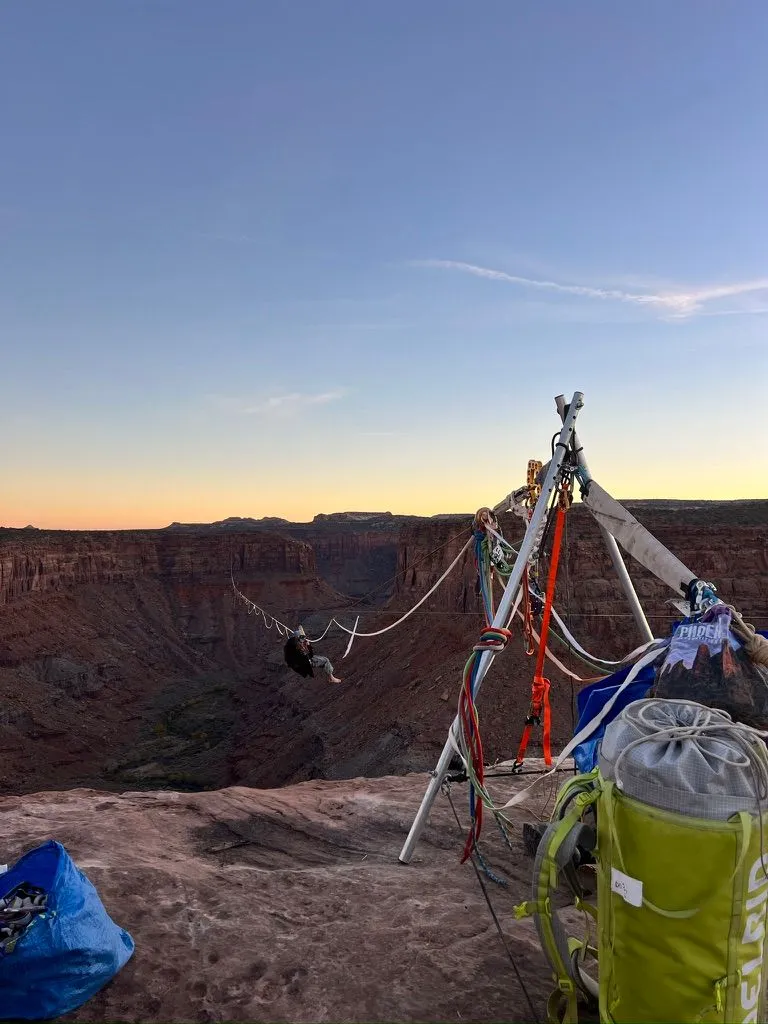
Most highlining discussions start with the walking. Foot placement, leash technique, trembling legs, mental game. That's the romantic part. But spend enough time in the sport and you realize that the rigging side is where all the real decisions happen — and where the difference between a great day and a catastrophe lives. This isn't a rigging course. You learn that from people, not articles. But here's a look at the gear decisions that actually matter, especially the ones nobody explains until you're already standing at the anchor wondering why your webbing won't seat properly in the weblock.
Section 1Why 25mm Webbing Lost the Long-Line Argument
For years, 25mm was the default. It's what most people learn on, what most weblocks are designed for, and what feels natural underfoot. Then people started pushing past 300 meters and ran into a problem that shorter lines never reveal: wind.
On a long line in any kind of cross-breeze, 25mm webbing turns into a sail. The main and backup start oscillating independently, slapping into each other, and once that oscillation builds it feeds on itself. I've watched a line go from walkable to completely unmanageable in under a minute when conditions shifted. At a spot in the Rockies, we had a 250-meter line rigged on 25mm that was walking fine all morning — and then the afternoon thermals kicked in and the main and backup started whipping independently, slapping together hard enough that you could hear the webbing crack from the anchor. Nobody walked it after that. We just sat at the bolts watching two lines beat each other to death for three hours until the wind died. The fix was simple in theory: go narrower. 20mm cuts wind surface area by roughly 20%. That sounds like a marginal improvement until you're actually on a 400-meter line and it's the difference between finishing your walk and bailing off. The catch is that going to 20mm isn't just buying different webbing. Every piece of hardware in the system — weblocks, shackles, line grips — was built around 25mm. Some adapt with spacers. Some don't adapt at all. It's a full system change.
Section 2The Sandwich System: Different Webbing for Different Jobs
Here's where long-line rigging gets genuinely interesting. Once you're above 200 meters, the smartest riggers stopped treating the line as one homogeneous piece of webbing and started thinking about it in sections. Different parts of the line have different jobs, so they should use different materials. This is the sandwich configuration.
The ends of the line — roughly 50 to 100 meters on the static side, about 100 meters on the tensioning side — get Spider Silk MK5. It's a Vectran-fiber webbing rated at 40 kN MBS, weighing 40 grams per meter. The surface has grip to it. It seats well in weblocks, holds against shackles, and tolerates the constant mechanical contact that happens at both ends of any line. This is the workhorse.
The middle section — everything between those end zones — gets Silk 99. Dyneema SK99 fiber. Same 40 kN MBS, but at 19 grams per meter. Half the weight. It stretches about 1.8% at 6 kN and has essentially zero creep, which means your tension measurements stay accurate across multi-day projects. You set it, and it stays set.
The weight difference is not trivial. Run the numbers on a 600-meter line: switching the middle section from Spider Silk to Silk 99 saves 12 to 15 kilograms of webbing. When you're hauling gear up a ridge at 6 AM with a headlamp on, carrying the equivalent of a small child less in your pack changes the entire logistics of the project. On one project in Moab, we had a 45-minute scramble up loose sandstone with packs pushing 60 pounds. My shoulders were cooked before we even started rigging. Every kilogram you can shave off the webbing goes straight back into your body's ability to actually function once you get to the anchor.
Section 3Why Silk 99 Destroys Hardware
This is the part that trips people up, and I've seen it happen. Someone hears "lighter, same strength" and thinks they can run Silk 99 end-to-end. They can't.
Silk 99's Dyneema SK99 construction prioritizes molecular-level strength and minimal weight. The tradeoff is surface friction — it has almost none. Single-wrap it in a weblock and it slips. Double-wrap it, and around 24 kN the front pin starts deforming. It's completely incompatible with line-locker rings. This isn't a defect. It's physics. Dyneema is slippery by nature, and the SK99 variant pushes that property to the extreme in exchange for the weight savings.
Spider Silk's Vectran construction deliberately sacrifices some of that weight advantage to provide the surface grip that hardware demands. That's why the sandwich exists — each webbing goes exactly where its properties are needed. Silk 99 in the middle where nothing touches it but air. Spider Silk at the ends where metal is inevitable.
If you're new to this and wondering where the line between "rigging knowledge you can read about" and "rigging knowledge you need a mentor for" falls — this is a good example of the latter. The community side of highlining is the real path into this sport.
Section 4Hardware That Actually Matters
Weblocks are the heart of the anchor system. Two dominate right now: the seaHorse from Slacktivity and the Alpine WebLock 6.1 from Balance Community. Both handle 20mm and 25mm with spacers, both use a spiral diverter design that retains 95%+ of webbing strength at the termination point, and both have working loads around 10 to 12 kN. The seaHorse has a slight edge in ease of threading. The Alpine is a bit more compact for packing. Either works. Pick one and learn it well.
Shackles are where most riggers go conservative, and that's the right instinct. Van Beest bow shackles in 1/2-inch or 12mm are the standard for primary connections. Steel. Heavy. Reliable. If you're counting grams for an alpine rig, the KingPin aluminum shackle is worth knowing about — 48 kN MBS at 107 grams, EN362 certified. I wouldn't replace every steel shackle with aluminum, but for specific positions in the system where weight matters and the loads are well understood, it's a legitimate choice.
Soft shackles — 12-strand Dyneema rope shackles — are essential for alpine projects. A 6mm version gives you around 40 kN at a fraction of the weight of steel. The critical thing is inspection. A soft shackle with abrasion damage can fail well below its rated load, and the failure mode is sudden. Check them before every use. Feel the entire length for fuzzing or flat spots. If anything looks wrong, retire it.
MightyLocks solve a specific problem on backup anchors. Traditional line-locker methods cut webbing strength by 25 to 30%. MightyLocks retain 85 to 90%. About $30 each. Not glamorous gear, but the kind of thing that quietly makes your entire backup system stronger.
Section 5Grog Splices: The Technique You Can't Learn From Text
A grog splice is a locked loop termination in Dyneema or similar cord. You use it at anchor connection points as an alternative to a metal shackle. Done right, it retains close to 100% of the cord's rated strength. It's lighter and more packable than hardware. On a big alpine project where every gram of metal you can replace with fiber matters, grog splices change the arithmetic.
I'm not going to try to teach the technique here because that would be irresponsible. It's fiddly. The difference between a properly locked splice and one that looks right but will pull through under load is subtle, and you can't feel that difference from a diagram. Find someone who knows how to do it, watch them, practice on scrap cord until it's second nature, and then trust it on a real project.
Section 6Where to Buy (and What to Look For)
Balance Community out of Colorado manufactures much of their webbing domestically and sets the bar for documentation — published MBS data, test results, clear working load specs. When I'm speccing out a project, their data sheets are the reference I check against. Slacktivity in Switzerland pioneered ISA certification standards and produces the seaHorse system. Spider Slacklines in Italy and Slack Inov in France are the main European alternatives, often with better pricing if you're already on that side of the Atlantic.
One non-negotiable: don't buy gear without published test results and clear MBS ratings. This isn't a place to save money on an unknown brand. Every component in a highline system is life-safety rated for a reason.
For the logistics side of long-line projects — getting webbing across gaps, anchor forces at big-line scale, and the WLL math that keeps everything within margins — the companion piece covers it. And if you're still figuring out where to find people to rig with in the first place, the community guide is the right starting point.