Most people skip Chengdu. They fly into Beijing or Shanghai, maybe do Hong Kong, and call it a China trip. That's fine, but it means they miss the city that's arguably the most livable, most fun to eat in, and most interesting to wander around as a foreigner who doesn't speak Mandarin. Chengdu doesn't have the skyline drama of Shanghai or the historical weight of Beijing. What it has is 16 million people, the best food in China, and a pace that feels almost Mediterranean for a city its size — people here actually sit down and drink tea in the middle of the afternoon. On purpose.
I ended up in Chengdu almost by accident — a cheap internal flight from Shanghai that I booked because someone at a hostel said the food alone was worth the detour. The airport was modern and efficient, which tracks for China, but the taxi ride into the city threw me. I'd been in Beijing and Shanghai, where everything felt like it was straining to impress you. Chengdu felt slower. People were playing mahjong on the sidewalk at 3pm on a Tuesday. Old guys with birds in cages were sitting in parks, just hanging out. For a city of 16 million, it had the energy of a place with nothing to prove.
Section 1The Logistics Problem (and the Simple Fix)
Here's the thing nobody tells you until you're standing in a train station staring at a ticket machine that won't accept your passport: you can't ride China's high-speed rail without Chinese ID or a linked Chinese bank account. I'd been in countries where transit was complicated before — navigating Medellín's systems took some figuring out — but China's is a different kind of friction. The infrastructure is world-class. The access for foreigners is not.
The fix is DiDi. It's China's Uber equivalent, it has an English interface, and it accepts Alipay or WeChat Pay. A 90-minute ride across the city costs around $10 USD, which is absurd. You'll spend more time in cars than you would on the bullet train, but the cost is negligible and the drivers generally know what they're doing. Just make sure you set up Alipay or WeChat Pay before you arrive — many places in Chengdu don't take cash or foreign credit cards, and you'll feel stranded without a payment app loaded.
Chengdu sprawls. Getting from one side to the other can easily take 45 minutes even on a direct route, so group your activities by area. Don't try to do the panda base in the morning and Dujiangyan in the afternoon — that's two hours of driving right there.
Section 2The Panda Base at Dawn
The Chengdu Research Base of Giant Panda Breeding is the one thing everyone does, and it's one of those rare tourist attractions that actually delivers. But timing matters. Show up at 7:30am. Not 9. Not 10. At 7:30.
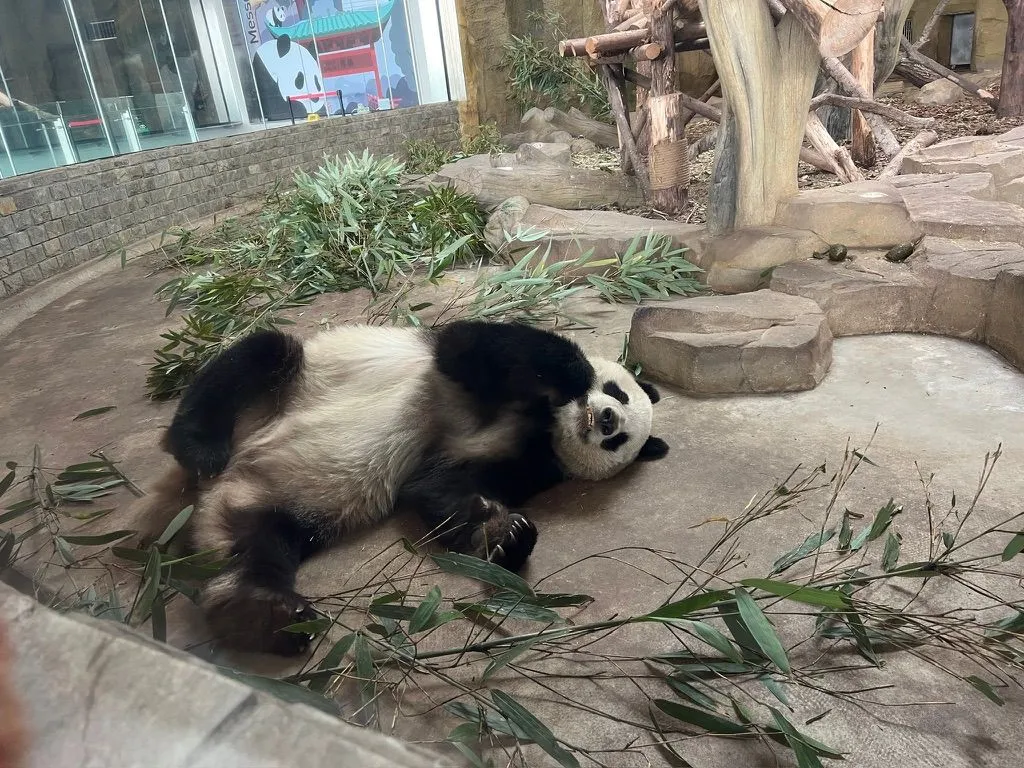
Early morning is feeding time, and the pandas are genuinely entertaining. The teenagers — maybe a year old, clumsy and oversized — steal bamboo stalks from each other, roll off platforms, and climb things they clearly shouldn't be climbing. One sat in a tree fork, wedged in at an angle that looked structurally impossible, just chewing bamboo and staring into the middle distance. One teenager — maybe 80 pounds of uncoordinated fluff — spent a solid five minutes trying to climb onto a platform that was clearly too high. It would get halfway up, lose its grip, slide back down, sit there for a moment as if reconsidering its life choices, and then try the exact same approach again. The crowd was losing it. The panda was completely unbothered.
By mid-morning, they're mostly sleeping. Still cute, but you're essentially looking at furry boulders draped over rocks. The red pandas are in a separate area and worth the walk — they're smaller, faster, and look like someone designed a fox but got distracted halfway through.
Practical note: buy tickets online in advance. The base limits daily visitors, and weekend slots sell out. Budget about 3 hours for the whole park.
Section 3Eating in Sichuan (The Main Event)
I've eaten well in a lot of places. Mexico City's food scene set a high bar. But Chengdu operates on a different level, because here the baseline is so high that even the cheapest hole-in-the-wall spot is usually good. UNESCO designated Chengdu a City of Gastronomy, which sounds like bureaucratic marketing until you eat here and realize they undersold it.
The flavor you need to know is mala — a combination of Sichuan peppercorn (which numbs your lips and tongue, a genuinely strange sensation the first time) and chili heat. It's not just spicy. It's spicy and tingly and a little bit addictive once you get used to it.
Hot pot is the essential Chengdu experience. You sit around a bubbling cauldron of crimson, oil-slicked broth, and cook raw ingredients in it: paper-thin beef slices, duck intestines (better than they sound — they curl up and get chewy in a satisfying way), lotus root, mushrooms, leafy greens. If you're nervous about the heat, order a yuanyang pot — half spicy, half clear broth. Huangcheng Laoma is a reliable pick with an English menu, but honestly, just walk into any hot pot place that's packed with locals and you'll do fine. A full meal with beer runs about 80-120 yuan per person ($11-17 USD).
Mapo tofu at Chen Mapo Tofu on West Yulong Street. The restaurant claims to be the original, dating back to 1862. The tofu is silky, almost custard-like, swimming in a sauce of ground pork, chili oil, and enough Sichuan peppercorn to make your whole mouth buzz. It costs almost nothing.
Dan dan noodles are everywhere — thin wheat noodles in a sesame-chili sauce with ground pork and crushed peanuts. Good ones have a layer of chili oil pooled at the bottom that you mix up just before eating.
Chuanchuan xiang is the street food version of hot pot: skewered ingredients dunked into communal broth. Jinli Old Street is the tourist-friendly spot for this, though the prices are slightly inflated. The taste is still good.
One thing I didn't expect: kung pao chicken in Sichuan tastes nothing like what you get outside China. It's drier, spicier, less sweet, and loaded with whole dried chilies and peanuts. The American-Chinese version is a different dish entirely. The meal that rewired my understanding of Chinese food was at a tiny hot pot spot near Kuanzhai Alley that didn't have an English menu or an English-speaking staff member. I pointed at what the table next to me was eating, and they brought out a bubbling pot of crimson broth that smelled like it could strip paint. The first bite of duck intestine — which I'd ordered by pointing — was a revelation. Chewy, spicy, numbing, and somehow deeply satisfying. I went back the next night.
Section 4Dujiangyan: The Day Trip That's Actually Worth It
About 60km northwest of Chengdu, Dujiangyan is an irrigation system built in 256 BC that's still in active use today. I know — "ancient irrigation system" doesn't sound like a compelling day trip. But the engineering is genuinely wild once you understand what's happening. The system diverts and channels the Min River to prevent flooding on the Chengdu Plain, and it was built without a single dam. The whole thing uses the river's own current and geography to regulate flow. It's been running for 2,200 years. Two thousand two hundred years.
The site itself is a park with walkways and bridges over the rushing water. The Anlan suspension bridge sways underfoot as you cross, and below you the river splits at the Fish Mouth levee — the original diversion point. It's loud. The water moves fast. You can stand there and watch the same physics that ancient engineers figured out still doing its job.
Guanxian Ancient Town is nearby and worth a walk-through if you have the afternoon — traditional architecture, tea houses along the river, and significantly fewer tourists than the main attraction. The whole day trip runs about an hour each way by DiDi.
Section 5Shopping and the Guangzhou Pipeline
Chengdu has serious shopping partly because of its proximity to Guangzhou, China's manufacturing and fashion hub. Taikoo Li on Chunxi Road is the high-end outdoor mall — all the luxury brands, modern architecture, good people-watching. But the more interesting shopping is in the markets where factory surplus and samples end up. I ended up at a market near Chunxi Road where factory surplus was piled on tables in no particular order — a fire sale aesthetic with surprisingly good quality buried in the chaos. No haggling; most things had fixed prices scrawled on masking tape. I bought a jacket that looked like it was destined for a European brand and a pair of shoes that I'm still wearing. The volume of stuff was overwhelming — entire floors of bags, shoes, electronics, clothing — and the trick was knowing when to stop looking and just leave.
If shopping isn't your thing, Chunxi Road is still worth walking for the energy alone. It's one of the most crowded pedestrian streets I've seen in Asia, which is saying something.
Section 6Practical Notes for Foreign Travelers
- VPN is essential. Install one before you arrive. Google, Instagram, WhatsApp, and most Western apps and sites are blocked. Without a VPN, you're cut off from everything except Chinese apps.
- Set up Alipay or WeChat Pay before your trip if possible. China has largely moved past cash, and many places won't take foreign cards. This is the single most important logistical prep you can do.
- English is rare. Outside of major hotels and tourist attractions, almost nobody speaks English. Download offline Chinese in Google Translate. The camera translation feature is a lifesaver for menus.
- The metro works and accepts foreign passports for ticket purchases, but the network doesn't reach everywhere. Combine metro and DiDi for the best coverage.
- Best time to visit is March through June or September through November. Summers are hot and humid, winters are grey and damp. Chengdu is famously overcast — locals joke that dogs bark at the sun because they see it so rarely.
If you're building a broader Asia trip, Hong Kong makes a natural pairing — it's a common transit point for flights into mainland China, and the contrast between the two cities is stark enough to be worth experiencing back to back.
Chengdu doesn't try to impress you. There's no iconic skyline shot, no single monument that sells the city. It wins you over with food, with the weird slow pace, with pandas being ridiculous at dawn. It's one of those places where the actual experience is better than any photo of it — which, in the age of Instagram tourism, feels increasingly rare.