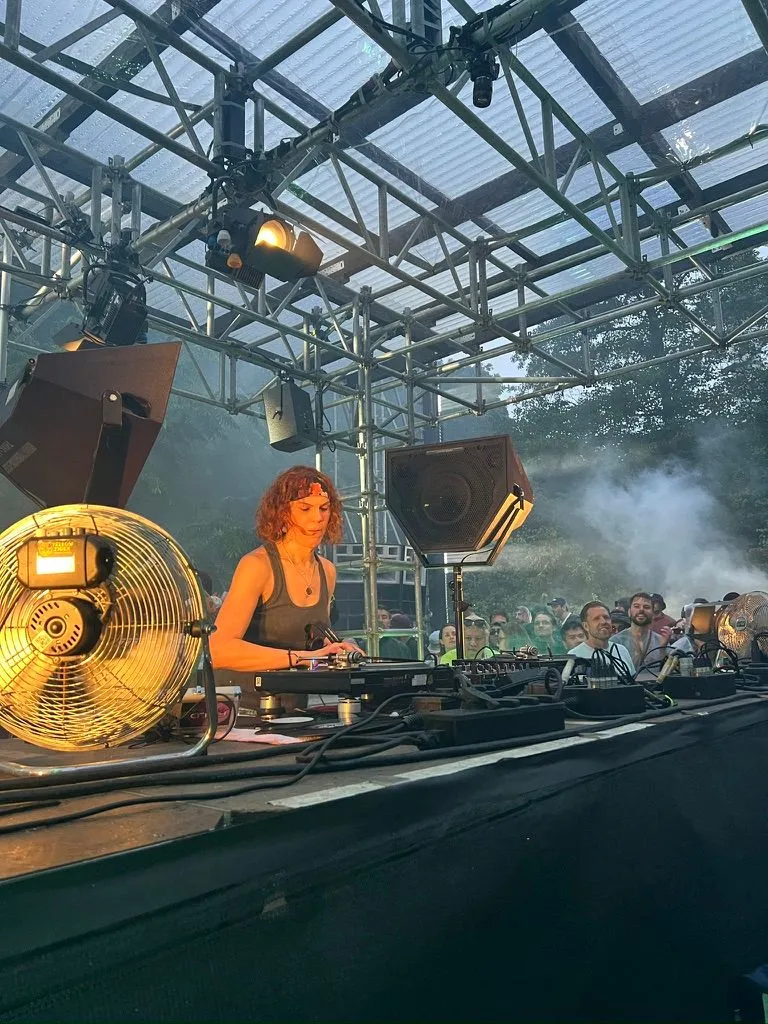
Most festival cities tolerate their festivals. Amsterdam was built for them. That sounds like marketing copy, but spend a week here during any major event and you'll feel the difference in your bones — or at least in your legs, because you'll be biking everywhere at 2 AM with a few thousand other people and nobody will look twice. The city runs over 300 festivals a year, and the infrastructure doesn't buckle under any of them. Trams still run. Ferries still cross the IJ. The Albert Heijn on the corner still has your overpriced oat milk at 7 AM. The festivals just... happen, layered on top of a city that keeps doing its thing.
I've done festivals that require a 45-minute shuttle bus from a dirt parking lot to reach the main stage. Amsterdam is the opposite of that. You bike to the venue, you bike home, you sleep in a real bed, you eat food that didn't come from a generator-powered food truck. It changes the whole equation. My first Dekmantel morning, I ate a stroopwafel from a market stall, biked twenty minutes through a park, locked my bike next to about five hundred other bikes, and walked into a forest where someone was playing ambient techno at noon. No wristband scanner drama, no security theater, no hour in a parking lot. I went from buying groceries to dancing in a forest in the time it takes to watch a sitcom episode.
Section 1Dekmantel: The One That Keeps You Coming Back
Dekmantel runs late July into early August in the Amsterdamse Bos — a massive park south of the city center that transforms into a multi-stage electronic music site for five days. Around 150 acts across house, techno, ambient, and whatever genre-defying corners the programmers have been digging into that year. Names like Four Tet, Jeff Mills, and Honey Dijon share the bill with DJs you've never heard of but will be following on SoundCloud by Sunday.
What makes Dekmantel different from the mega-festivals isn't the lineup, though. It's the setting and the pacing. The Amsterdamse Bos is a real forest — tall trees, dirt paths, dappled light cutting through canopy onto the crowd. The bass from one stage bleeds into bird noise from the next clearing. There's a looseness to it that you don't get at festivals designed by logistics companies. People drift between stages at their own speed. Nobody's sprinting to catch a set because the next one is a 20-minute hike across a dusty field. The stages are close enough that you can wander, and the sound design is good enough that they don't bleed into each other too badly.
The practical upside: the Bos is a 30-to-40-minute bike ride from most central neighborhoods. You ride there through actual bike lanes, lock up at the entrance, and you're in. No parking lots. No shuttles. No surge pricing. When the last set wraps — usually around midnight on the main stages, later on the smaller ones — you ride back into the city and you're home in half an hour. If you're coming from somewhere like Burning Man or even a UK festival where the exit logistics can take hours, this feels almost unreal. Biking home from Dekmantel at 1 AM is its own experience. You're in a stream of cyclists — some of them still buzzing from the music, some of them just commuting home from a normal evening — and the bike lane along the Amstel River is quiet enough that you can hear the water. The city is still lit but calm, and you're back in your apartment in time to make tea before bed. It feels civilized in a way that festival exits almost never do.
Day passes run around €75-85, and five-day passes sell out months in advance for roughly €250-300. If you're building a European festival summer, Dekmantel is a smart anchor — fly into Schiphol, rent an apartment for the week, and you still have two or three days before or after the festival to eat your way through the city.
Section 2Amsterdam Dance Event: The City Becomes the Club
If Dekmantel is a focused festival with a clear boundary, ADE is the opposite — five days every October where the entire city becomes one distributed, decentralized club night. Over 2,500 artists across 140+ venues. Paradiso, Melkweg, Shelter, Claire, the Gashouder, plus dozens of pop-up venues, warehouses, and bars that only do programming during ADE week. The conference side pulls in industry people during the day, but the real action is at night.
Here's what most first-timers get wrong about ADE: they try to plan it like a normal festival. They build a spreadsheet of must-see sets and try to hit five venues in one night. This doesn't work. ADE rewards commitment to a single venue or a single night's lineup. Pick one spot, stay there, let the programming carry you. The venues are small enough that you're actually close to the artist — Shelter is underground, literally, with a ceiling that makes the bass feel like it's inside your ribcage. Paradiso is a converted church where the acoustics do something special to anything with a sub-bass line. These rooms have character that you can't replicate in a festival tent.
The logistics are simple because you're just... in Amsterdam. You get on a tram. You bike. You walk along a canal at 4 AM eating a kroket from FEBO because the automat never closes and hot fried ragout hits differently after six hours of techno. That's the ADE experience — not one big event, but a city-wide mood shift where the volume goes up everywhere for a week. If you've spent time in Berlin's club scene, ADE has a similar energy but compressed into a shorter timeframe and distributed across more venues.
Section 3Beyond the Big Two: Year-Round Programming
Amsterdam's music calendar doesn't hibernate between Dekmantel and ADE. Awakenings runs a traditional Easter weekend event at the Gashouder — a former gas storage facility in the Westergasfabriek complex that's become one of Europe's best techno rooms. The circular brick walls create a reverb that's hard to describe if you haven't been in it. Pitch Festival does drum and bass and UK bass in August. Loveland runs near-monthly parties plus a summer festival. And then there's the club circuit that just... keeps going.
Paradiso and Melkweg both run year-round programming that goes well beyond dance music — live bands, hip-hop, jazz, experimental stuff. De School, before it closed, was Amsterdam's answer to Berlin's Berghain, and the city still hasn't fully replaced it. Shelter in Noord took over some of that energy — it's across the free ferry from Centraal Station, underground, and open late enough that you can show up at 2 AM and still catch four hours of music. One night during ADE I took the free ferry from Centraal to Noord, walked into Shelter around midnight, and didn't come back up until 5 AM. The room is genuinely underground — low ceiling, concrete, the kind of space where you lose all sense of time. The DJ that night was playing this stripped-back, hypnotic techno that would have bored me in a big room but in that basement felt exactly right. When I came out, the sun was coming up over the IJ and the ferry was full of people heading to work. Two worlds passing each other on the same boat.
The point is: you don't need to time your trip around a specific festival. If you're in Amsterdam for any reason — thrifting, biking, eating — there's a strong chance something good is happening that week. Check Resident Advisor and the venue calendars a few days before you arrive.
Section 4Getting Around: Bikes, Ferries, and the Late-Night Tram
Amsterdam has roughly a million bicycles for about 900,000 residents. The math alone tells you how this city moves. Dedicated bike lanes cover every major route, bikes get priority at most intersections, and drivers are trained to check for cyclists before opening their car doors. For festival logistics specifically, biking is almost always the move — faster than transit, cheaper than a cab, and you're never waiting for anything.
Bike rentals run €10-15 per day from shops all over the city. A-Bike near Tesselschadestraat is convenient if you're staying near Vondelpark. Lock your bike properly — Amsterdam has a healthy bike theft culture, and a single cable lock won't cut it. Use the rear wheel lock plus a chain to something fixed. This isn't paranoia; it's standard practice for residents.
The GVB transit system handles everything else: 16 tram lines, 5 metro lines, night buses on weekends, and the free ferries across the IJ from behind Centraal Station. The ferries are the underrated piece — they run 24 hours, take bikes, and get you to Noord (where Shelter and NDSM Wharf are) in about 5 minutes. During ADE, when you might be venue-hopping between the center and Noord, the ferry is faster and more reliable than any other option. An OV-chipkaart (the Dutch transit card) or a contactless bank card works on everything.
Section 5Eating Between Sets
Dutch food gets a bad rap, and honestly some of it is earned — but Amsterdam's food scene is shaped more by Surinamese and Indonesian immigration than by traditional Dutch cooking. Surinamese cuisine is the move here: roti, broodje pom, saoto soup. Warung Spang Makandra in De Pijp has been doing it for decades. De Tokoman near the Waterlooplein is smaller and faster. Both beat any tourist-facing restaurant by a wide margin.
For late-night fuel, FEBO is the Dutch automat chain — coin-operated vending walls of hot snacks like kroketten and frikandellen. It sounds grim, it looks grim, but at 3 AM after a Shelter set, a hot kroket behind a little glass door is exactly what you want. The Indonesian rijsttafel (rice table) is worth doing once — a multi-course spread of small dishes that's better for a recovery day than a festival night. If you're coming from somewhere like Mexico City's food scene, Amsterdam won't blow you away, but the Surinamese stuff is genuinely great and hard to find at this quality anywhere else in Europe.
Section 6Practical Notes
- Best festival months: July-August for Dekmantel, Loveland, and Pitch; October for ADE; Easter for Awakenings. But something's always on.
- Where to stay: De Pijp, Jordaan, and Oud-West put you central without being in the Red Light District tourist crush. Noord is cheaper and closer to Shelter/NDSM but requires the ferry for everything else.
- Budget: Amsterdam is expensive. Hostels run €35-50/night, private rooms €80-120. Festival day passes €60-85. Food is manageable if you cook some meals and eat Surinamese instead of sit-down Dutch restaurants.
- Getting in: Schiphol is 20 minutes from the city center by train. Direct trains run every 10 minutes. Don't take a taxi.