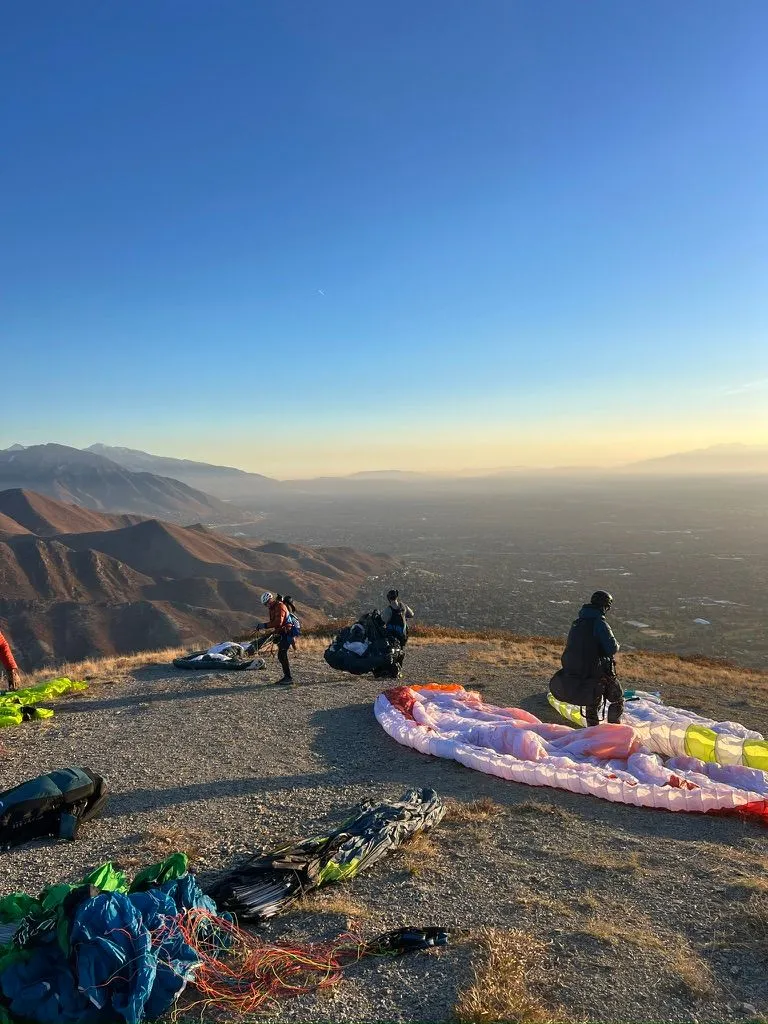
Here's the thing nobody tells you before your first speedflying lesson: your paragliding experience is both your biggest asset and your biggest liability. I showed up at Speed Fly USA's five-day crossover clinic at Point of the Mountain with a P2 rating, a couple hundred flights on my paraglider, and a mental model of how wings work that turned out to be about 60% wrong for what I was about to do. Speedwings look like small paragliders. They fly like a different species.
The crossover clinic is specifically for paraglider pilots. If you don't have at least a P2, you're looking at their full 10-day beginner course instead. That P2 requirement exists because you need to already understand airspace, wind assessment, and launch procedures — the clinic doesn't re-teach any of that. What it does teach is everything you thought you knew but actually need to relearn on a wing that's half the size and twice the speed of what you're used to.
Section 1Why Speedflying Is Not "Fast Paragliding"
I went in thinking speedflying was paragliding with a smaller wing. Faster descent rate, tighter turns, same basic physics. That framing lasted about an hour.
On a paraglider, you have time. You make a mistake — a sloppy turn entry, a late weight shift, a misjudged approach — and the wing forgives you. It oscillates, maybe collapses a cell or two, and you sort it out. The glide ratio gives you altitude to burn while you figure things out. A speedwing doesn't negotiate. An 8-meter wing at a 3:1 glide ratio means you're coming down fast and covering ground even faster. The inputs are smaller, the reactions are quicker, and the penalty for being late on a correction is measured in seconds you don't have, not minutes you can spare.
The first time I watched my instructor do a run on his speedwing, the proximity to terrain registered before anything else. He was carving turns maybe 20 meters off the slope, the wing banking hard enough that the tips were nearly vertical, and the ground was scrolling past at a speed that my paragliding brain couldn't reconcile with the idea of "flying." It looked more like skiing — the same relationship with terrain, the same continuous line-reading, the same consequence for a blown turn. That comparison turned out to be the most useful mental model for the whole week.
Section 2Ground Handling: The Part Nobody Wants to Do
Day one. You'd think we'd fly. We did not fly.
We spent the entire first morning — and a good chunk of the afternoon — on the ground, kiting speedwings in the training field. If you've ever ground-handled a paraglider, multiply the intensity of every input by about three. A speedwing is twitchy. The brake pressure is lighter, the wing responds faster, and overcorrections cascade instead of dampening out. On a paraglider, you can get away with slightly sloppy kiting technique because the wing is big enough to stabilize itself. On a speedwing, the margin between "wing overhead and stable" and "wing on the ground in a tangled mess" is about a half-second of inattention.
My instructor was relentless about this. When the wind picked up past what my 16-meter training wing could handle cleanly, he handed me his personal 8-meter. "Kite this for a while." I spent four hours straight fighting an 8-meter wing in gusty conditions. My forearms were burning. My shoulders felt like I'd been doing pull-ups all day. But something happened in those four hours that no amount of flying could have taught — the muscle memory for speedwing inputs moved from my brain into my hands. By the end of that session, corrections I'd been thinking about had become reflexive. At one point, the instructor stopped me and said, "You're still using paraglider hands. You're pulling full brake inputs when you need fingertip corrections." He made me do the next twenty minutes with just my index fingers on the toggles. It felt ridiculous, but the wing smoothed out immediately. That was the click — the moment I stopped trying to muscle the wing into position and started guiding it.
This is the part that separates good speedflying instruction from bad. Anyone can send you off a hill on a small wing. The schools that produce competent pilots are the ones that make you spend what feels like an unreasonable amount of time on the ground first. It's boring until you realize it's the foundation for everything else.
Section 3The Progression System
Speed Fly USA uses a progression approach that felt frustratingly slow in the moment and obviously correct in retrospect. You don't jump from kiting to full speedflying. There are intermediate steps, and each one has to be solid before you move on.
First flights are on larger speedwings — 16 meters — at gentle slope angles. These are closer to small paragliders in behavior, and they let you adjust to the speed increase without also dealing with aggressive handling. The launches feel familiar if you've paraglided, but the sink rate catches you off guard. On a paraglider, you launch and think about where you'll go. On a speedwing, you launch and immediately think about where you'll land. The whole flight happens faster than your paragliding instincts expect.
Then the wings get smaller and the terrain gets steeper. Each step down in wing size feels like the first time all over again. A 14 handles noticeably different from a 16. A 12 is another jump. And the really small wings — the 8s and 10s that the pros carve terrain on — are an order of magnitude more demanding than anything I flew during the clinic. Those come later, after a lot more hours.
The daily rhythm was consistent: ground handling in the morning (always), flights in the afternoon when conditions were right, and debriefs after each session where the instructor would pick apart what went well and what needed work. The debriefs were worth their weight — hearing someone describe what your body was doing wrong during a turn you thought felt good is a specific kind of humbling. During the debrief after my third flight, the instructor pulled up the video and pointed out that I was flaring way too early on approach — a paragliding habit where you start your flare at fifteen feet because you have the glide ratio to float it in. On a speedwing, that same flare height means you stall the wing and drop the last ten feet. "You need to flare at knee height," he said. "Trust the speed." It took two more flights before I could override the instinct.
Section 4Risk and Honesty
Speed Fly USA doesn't sugarcoat what this sport is. During the safety briefing on day one, the instructor was blunt: speedflying has a higher injury and fatality rate than paragliding. Full stop. The wings are less forgiving, the proximity to terrain is closer, the speeds are higher, and the margin for error is thinner. There's no version of this talk that makes it sound safe, because pretending it's safe would be irresponsible.
What they teach instead of pretending the risk doesn't exist is how to manage it systematically. Risk assessment before every flight: wind speed, wind direction, gusts, terrain, your own physical state, your skill level relative to the conditions. They use a progression model that keeps you inside your ability envelope and only expands it when the fundamentals are solid. The mantra is something like: the pilots who get hurt are the ones who skip steps.
This approach resonated with me because I'd seen the same philosophy in highlining — another sport where the consequences of cutting corners are severe, and where the culture has evolved toward deliberate mentorship and systematic progression precisely because the alternative is people getting hurt. The best instructors in both sports share that same quality: honest about the danger, structured about the learning, patient with the process.
By the end of day five, I felt ready to take speed flights on my own — but specifically at sites I'd assessed, in conditions I understood, on a wing size I'd demonstrated control over. Not "ready to go carve terrain on a 10-meter wing in the mountains." Ready to fly within the envelope I'd built. That distinction matters. Speedflying rewards patience and absolutely punishes overconfidence.
Section 5Why Point of the Mountain
Salt Lake City's Point of the Mountain is where this clinic happens for a reason, and it's not just that Speed Fly USA is based there. The site offers some of the most consistent flying conditions in the country. The Wasatch Range creates a thermal engine that produces reliable, flyable wind almost every day. Other spots might give you three or four flyable days in a week — Point of the Mountain delivers nearly all of them.
The terrain works well for training too. The slopes range from gentle to steep, so you can progress through increasingly aggressive terrain as your skills develop without needing to drive to a different site. The landing zones are large and forgiving. And because it's one of the highest-density flying sites in the US, there's always someone in the air to learn from — watching good speedflyers read terrain teaches you things that verbal instruction can't.
The pilot community at Point of the Mountain is worth mentioning on its own. Utah has a serious density of paraglider and speedflying pilots, and the culture at POTM is collaborative. People share conditions reports, offer to help you assess a new flight path, and generally want to see each other progress safely. After a day of structured instruction, hanging around the training hill and watching experienced pilots fly was its own education. If you've spent time at an XC clinic in Roldanillo or the flying sites in Voss, POTM has that same energy of a place that exists primarily because pilots congregated there and built something.
Section 6Gear: What I'm Flying Now
I left the clinic and bought my own setup: an Ozone Dragonfly 16-meter and a speed harness. The Dragonfly is the obvious choice for a first speedwing — it's designed for the transition from paragliding, with handling that's accessible without being mushy. The weight range goes up to 120 kg, so you're not going to outgrow it immediately, and it's capable enough that you won't feel like you need to upgrade after your first twenty flights.
Total cost for the wing, harness, and a reserve was roughly $4,500. The clinic itself runs around $1,500 for the five days, which includes equipment use during the course. That's a real investment, but consider the alternative: trying to teach yourself speedflying by watching YouTube videos and hoping for the best. I've seen what that produces, and it's not pretty. Proper instruction isn't optional in this sport — it's the thing that determines whether you progress or end up in the ER.
Section 7The Crossover: What Changes in Your Head
The most valuable thing I took from the five days wasn't a technique or a maneuver. It was a recalibration of how I think about flying in general.
Paragliding trains you to think in terms of altitude and time. You're always looking up — where's the next thermal, how high can I get, how long can I stay airborne? Speedflying flips that orientation entirely. You're looking down and forward. The terrain is the thing. Reading the slope, anticipating changes in grade, planning your line through the terrain the same way a skier reads a run. It's a fundamentally different relationship with the ground, and learning it changed how I fly my paraglider too. I came back to regular paragliding with better ground awareness, better approach planning, and a more honest assessment of my own margins.
If you're a paraglider pilot thinking about speedflying, here's my honest take: do it, but do it through a structured program. The skills transfer is real but incomplete — your airmanship gives you a head start, but the execution is different enough that you need proper instruction to bridge the gap. Don't let the fact that you can fly a paraglider trick you into thinking you can fly a speedwing. They're cousins, not twins.
And if the idea of another compressed-learning clinic appeals to you — a week of total immersion in a new discipline — the format itself is addictive. There's something about showing up at a school with zero ability in a specific skill and leaving five days later with the tools to practice independently. Learning XC in Roldanillo was the same experience in a different context: different skill, same trajectory from clueless to competent. The pattern scales.
A month after the clinic, I took the Dragonfly to a ridge site outside Salt Lake and did my first solo session. The conditions were mellow — steady northwest wind, smooth ridge lift — and I spent an hour running laps on the slope, practicing the figure-eight ground handling pattern until it felt automatic. On my last run, I caught a clean gust off the ridge and carved a turn close enough to the terrain that I could hear the sagebrush rustling below me. For about three seconds, the relationship between my body, the wing, and the ground clicked into something that felt more like skiing than flying. That was the moment I understood what speedflying is actually about.